Thursday, December 20, 2018

Research Project - Extreme Environments

Background
The redesigned BC Curriculum emphasizes hands-on experiential learning. This isn’t always possible or desirable. Scientists do much more than simply conduct experiments. Scientists classify, observe, research, and above all think critically about the natural world.

It is very difficult to create hands-on learning and experimentation when the topic is Space. The obvious choice is to have students do a research project. But, many research projects are simply a checklist of facts to find on the internet and then put into some kind of slide show or poster presentation. It amounts to a copy and paste exercise with little meaningful thinking required.

However, if the research question is crafted carefully, the research project can be an excellent way for students to consider and develop criteria, think critically, evaluate based on criteria, and communicate a scientific argument.

Sample Inquiry Research Question
Some sample inquiry questions for the Grade 6 Space unit can be found on the Curriculum document by hovering over the Big Idea. One of those questions is:

“What extreme environments exist on Earth or in our galaxy?”

I might pose this question to my students like this:

Describe the extreme environment on one of the following objects in our galaxy
(asteroids, comets, Mercury, Venus, Mars, Neptune, Pluto, the moon, Europa, Io…)

The projects I am likely to see will be detailed information about the environment including temperature, pressure, atmosphere, lack of water, lack of food, lack of life. It will probably include some nice pictures. And students will learn a lot about the conditions on their topic.

But, I think we can do better…

Why is this not good enough?
I see 2 major problems with the question as it is written above:

  1. Students are not required to think deeply about the content. They only have to find information and relay it to the teacher and the class.
  2. Students will only learn details about 1 topic. Even if students share their learning through an oral presentation, they will not have interacted with the other topics to the same degree.

To correct these problems, we need to re-craft the question so that it engages students in thinking critically about the topic. And we can structure the sharing of learning so that it provides opportunities for students to connect with other topics in a meaningful way.

Re-crafting the Extreme Environment Research Question
I propose restating the inquiry question like this:

“Which object in our galaxy is the most extreme environment?“

This simple change turns our project from a fact-finding mission to a critical thinking extravaganza!

Notice that students will still have to find all the facts about the environment as they would have in the previous questions. But now they have to do something with those facts. They have to evaluate the conditions in the environment against some criteria to determine if it is the most extreme.

Notice also that students will have to compare the conditions on their object with conditions on other objects from other students’ projects. And not just hear about the facts from an oral presentation. But actually interact with the information to decide which is the most extreme environment in the galaxy.

Both of our problems have been addressed.

Some thoughts about structuring the project
Defining the criteria
Students need to know what constitutes an extreme environment. Starting with more familiar environments on earth (deserts, arctic, deep caves, oceans, mountain tops), the class can discuss and agree upon what criteria to use to evaluate an extreme environment.

In fact, this is a good way to practice the skills needed for the space project. I might have brief information cards for earth environments. Hand out a card to each student. Let them take 5 minutes to read and make notes about the environment based on the criteria. Then pair off and debate which is the most extreme. Take back the cards, redistribute new cards, repeat. Students can self-assess their ability to use evidence to support their claim and think critically about the topic. They will be well-prepared to use these skills in the space project.

The research
If only 1 object is assigned for research, it is mostly just finding facts. So, the initial question might randomly assign 2 objects to each student (or group). This starts the critical thinking right away. They must decide which of the 2 is the most extreme and provide evidence as a part of a scientific argument.

Sharing the learning
Students can still create a slideshow or poster. But it is far more important that students are able to discuss the evidence and debate which is more extreme using criteria.

Rather than oral presentations, students could be paired or grouped to share the object they researched. And discuss and debate with the other students to reach some consensus about which is most extreme. The idea here is not to “win” the argument but rather to critically consider evidence and make an evaluation with colleagues.

The groups could then rotate in a “speed dating” style activity so that all objects are considered. This allows students to be exposed to information about all the researched objects while engaging in critical discussion with classmates about the criteria.

Communicating the scientific argument
Although consensus is desired, it may not be possible. Students may disagree about which environment is most extreme. That is OK. There are ongoing disagreements in the scientific community.

What is important is that students are able to communicate their reasoning using evidence.

“I think Mercury is most extreme because it is small and it was my project. I like Mercury.”

There is some evidence here (small) but also some emotional attachment. And “small” is not a good criteria for extreme.

“Mercury is most extreme because it has high temperatures and no water.”

This is a much better argument because it uses evidence based on criteria. We might not agree with the conclusion, but at least it is a well constructed argument.

After the group sharing, it might be a good summative assessment to have students craft a final argument for which is the most extreme environment. This could follow the Claim, Evidence, Reasoning format where students back up their claim with evidence and explain their reasoning using scientific principles.

Extending the project (Applying and Innovating)
Some students will want to extend their learning. One way to do this is to ask students to design and create a way to survive in the extreme environment.

Notice that this extension is a lot different than simply asking students to research another object (like a black hole). It is not more work of the same type. It is asking students to apply their learning to a new situation. Students would need to have a good grasp of the details of the extreme environment but also understand the effect that would have on human life. They might connect with learning from the Body Systems unit. They would need to do more research on how to survive in extreme conditions on earth and in space. This is a true extension because it requires higher order thinking and application of learning.

A simple change
This all started with just a small change to the inquiry question. Students become scientists who research and think critically about what they discover. Crafting the question carefully elicits deeper thinking, scientific reasoning and argumentation.


Monday, June 4, 2018

Infusing Science in Story Workshop - Intermediate Grades


Story Workshop is gaining popularity in many classrooms. I am even hearing about teachers continuing to use Story Workshop in intermediate grades. It got me thinking about how science could be woven into the writing process when play-based learning is not as prominent as in early grades.

In grade 5 Chemistry, students explore the Big Idea: Solutions are homogeneous. There a lot of hands-on inquiry possibilities. I am imagining a lab with a lot of white powders (salt, sugar, baking soda, flour, chalk dust, laundry detergent, cold pack crystals). Students can explore various mixtures and observe properties like dissolving, temperature changes, fizzing (baking soda and vinegar). Students can go much deeper with solubility in a more formal lab. Looking at various changes like amount of salt, amount of water, temperature of water, stirring or no stirring. Here is a link to a document on my Google Drive with lab ideas about solubility.

What if students came in a few days after the lab and found one unknown white powder on their desk? They would have to run some tests to identify it. Add water. Does it dissolve? Heat up? Fizz? Make a Claim stating what the powder is based on Evidence from various tests and Scientific Reasoning.

Related image

Better yet, what if they came in and found a crime scene? A small part of the classroom set up to look like someone ransacked it and stole something. And one of the main clues is a footprint in an unknown white powder. Now you have the elements for a Story Workshop. What is the story about the crime? What was stolen? Who stole it? Who is investigating? How do they catch the thief?

And they would have to write about the science to explain how the white powder clue helped solve the crime. How did investigators figure out what it was? Does it taste salty? Did they add water and notice a temperature change? Did they spill vinegar on it and see it fizz? How does that lead them to the thief? This might also lead them to research forensics and further their scientific understanding.

Embedding science materials into a Story Workshop scenario allows students to weave their science learning into their stories.


A note on materials:
It is important to have a variety of white powders that will react in different ways. Salt and sugar for dissolving, baking powder to fizz with vinegar, and some powders that don't do much at all like flour or chalk.

I suggest using So Clean! laundry detergent from London Drugs (also available from Amazon.ca). It will heat up when you add water.

And I also suggest the cold packs at London Drugs in the First Aid aisle. These are not the ones you put in the freezer, but the ones you activate by squeezing. Just cut them open and remove the small bag of water that is inside (squeezing breaks this bag and mixes the water with the crystals starting the reaction). Then you have crystals that will get cold when added to water.

Neither of these are toxic but I would have students wear gloves, safety glasses, and wash their hands after. That’s just good lab safety behaviour.

Friday, May 25, 2018

I Wish I Had a Bag of Atoms

I try very hard to create learning opportunities for students to engage in "hands-on" inquiry. This works very well in physics with toy cars, potato cannons, and electric circuits. But when we start to learn about the structure of the atom, chemistry, and quantum mechanics, I am a little stumped. I wish I had a bag of atoms I could dump on the table for students to play with.

Recently, I was at Guildford Park Secondary to work with the science department in creating inquiry activities to align with the new BC Curriculum.  The teachers were frustrated about the lack of hands-on activities and labs for the grade 9 chemistry Big Idea: The electron arrangement of atoms impacts their chemical nature. This essentially means using the Periodic Table to understand how the electrons in the outer shell of atoms determine how chemical bonding will take place. Ionic and covalent bonds forming chemical compounds.

Students need to practice identifying atoms, maybe draw some Bohr models, and name the compound. Unfortunately, this usually means a whole lot of worksheets like these:


Now, these worksheets aren't horrible. They give students the practice they need. And they do require more than just naming compounds and writing chemical formulas. Students need to use the periodic table, draw Bohr models, and calculate some things. But there is not a lot of thinking required. I wish I had a bag of atoms!

I can hear you saying, "But wait! Don't we have atomic model kits? That's like a bag of atoms." The teachers at Guildford Park brought out the model kits and gave me a mini-lesson on ionic and covalent bonding (it had been so long since my last chemistry class, I had forgotten everything). I built some compounds and then asked, "How do I know which is ionic and which is covalent just by looking at it?" There was no visual way to tell. The bonds look identical.

An idea had been percolating in the back of my mind throughout our discussion. What if we created our own bag of atoms? It might look something like this:


What if students were given Bohr models and simply asked to create as many compounds as they could? Instead of a worksheet telling them to combine Hydrogen and Fluorine, they have to decide which elements they could combine. Instead of a worksheet asking them which type of bond it is, they have to decide how to bond the elements. Instead of a worksheet with 10 questions, they have to decide how many combinations they can make. The act of deciding changes everything. Students are doing the thinking. And it is deep thinking.

I would start with the 10 elements on the left that include the chemical symbol. Students must find a way to combine all the elements into compounds without having any left over (Helium is thrown in for fun).

Here is a sample of what this might look like:


Notice how the two types of bonds are now visually obvious. At the top, there are two ways to visualize covalent bonds. At the top left, the pictures have been trimmed back to allow the electrons in the Hydrogen atom to be taped onto the Oxygen atom overlapping the outer electron shell. At the top right, the sharing of electrons is emphasized by the use of brad pins to bond the two Hydrogen atoms. I like the brad pins because they demonstrate the strength of covalent bonding. At the bottom, an electron from the outer shell of the Berylium atom has been cut out and taped into the outer shell of the Oxygen atom. The elements are placed near each other to show the ionic "bond" through electrostatic forces between the ions.

Later on, I would repeat the process with the 10 unnamed elements on the right. In fact, I might choose to start with the unnamed elements and ask students to simply sort them however they wish. I imagine students will notice how many shells each element has and how many electrons are in the outer shells. Which is exactly how the Periodic Table is organized. That would lead naturally to a discussion of the Big Idea: The electron arrangement of atoms impacts their chemical nature.

I tried this out with Science Department Heads. I started with the worksheets, then brought out the Bag of Atoms. We talked about how the activity is different and improves on the worksheets. One comment encapsulates everything I wanted to accomplish. "We had to think."

Here is a link to my Bag of Atoms cards.

Special thanks to the Science Department at Guildford Park Secondary who were instrumental in developing the Bag of Atoms concept and activities

Wednesday, May 23, 2018

Infusing Science in Story Workshop - More Thoughts

One of the things I am very conscious of in thinking about leveraging Story Workshop into a Science Workshop is that I don't want to change what is already happening. I am not trying to hijack Story Workshop and convert it into a science activity. But I am thinking about small changes that will allow students to include their science learning as part of their stories.

I revisited the Grade 1 class doing Story Workshop. As I debriefed with the amazing classroom teacher, Mrs. Mace, we started to talk about what Science Workshop could look like.

And then some magic happened!

Mrs. Mace is very intentional in attempting to move students' writing skills forward. We were talking about how we could help improve student writing by teaching them to add adjectives. "One day, a cat went to the sea" could become "One day, a cat went to the cold sea." The addition of the adjective adds detail and depth to the story.

But how do we weave in science? Mrs. Mace shared that they were currently studying the grade 1 Big Idea: Matter is useful because of its properties. Properties... Adjectives... It's the same thing right?

What if students revised their stories to include adjectives that were inspired by properties of matter? What if the materials used to inspire stories were the same materials being studied in science?

That rock in the story becomes a hard rock. The bark on that tree becomes rough bark. The cottonwood blowing in the wind becomes fluffy cottonwood. Student writing includes size, shape, texture and many more descriptive words. Students consciously include science thinking into their stories.

And when they share their stories, they are also sharing their science learning.


Thank you...
to Mrs. Mace and the amazing Grade 1's at Bear Creek Elementary for inviting me into their classroom.


Sunday, May 6, 2018

Infusing Science in Story Workshop

In my role as Science Helping Teacher for the Surrey School District, I have the privilege of visiting classrooms and seeing some amazing teaching and student learning. Recently I was able to see a grade 1 class engaging in Story Workshop.

I won't be able to do justice to this activity, but the basic idea is to lay out some materials on tables for students to play with. The open play time is fairly unstructured except that students know their play is leading to a story. They are encouraged to play for as long as they like to develop a story using the characters and materials on the tables. When they are ready, students begin to write and illustrate the stories they invented during play.

My first thought on seeing Story Workshop was, "Why can't we do something like this for science?" Open play leading to writing about scientific concepts. So, in my typical professional manner, I am stealing this idea and adapting it. Let me introduce Science Workshop.

My intent is to change as little as possible. The routine of Story Workshop is wonderful and the students are well-versed in the process. All I really want to do is infuse science into the play time.

One problem I found immediately was that science "play" tends to be (and perhaps needs to be) more structured. We want students to be changing variables, establishing controls and collecting data. Hard to do in open play time. But, after leading some workshops last week, I think I am starting to see what this might look like.

Here's an example. One of the workshops last week was about using picture books to teach science. I shared an inquiry activity using Sheep in a Jeep to explore the grade 2 Big Idea: Forces influence the motion of an object. There was a variety of materials on the tables and teachers were asked to re-create a scene from the book. The next stage would be to ask what other adventures the sheep could get into. Participants would use the materials to create a new story for the Sheep in a Jeep.

Sound familiar?

Basically the Story Workshop framework is the same. But the materials chosen relate to the science concepts being learned in the classroom. Students would still write stories. It is certainly not going to be technical scientific writing or a lab report. But the new adventures would undoubtedly involve forces and motion. Are the sheep launched from a giant slingshot? Parachute of a cliff? Ride a roller coaster? Orbit a planet? Pulled by a giant magnet?

And as students share their stories, they can be explaining what forces are involved to influence motion. Extending their understanding to new scenarios. Science woven into story.

Sheep in a Jeep - Using Picture Books to Teach Science

Sheep in a jeep on a hill that's steep!

I read this book to my daughters about a ker-billion times and never noticed it was actually about forces and Newton's Laws. And I am a high school physics teacher.

At a workshop this weekend, I was sharing with Surrey teachers how to use picture books, like Sheep in a Jeep, to teach science. I challenged the teachers to try to re-create a scene from the book using only the materials they had on the table. Most groups re-created the scene where the sheep rolled the jeep down (gravity) a steep hill (Hot Wheels track) and got stuck (friction) in gooey mud (rolled up fabric).

But one group chose a seemingly simple scene that shows the power and depth of using picture books to teach science.

In this scene, the sheep are trying to pull the jeep out of the gooey mud. They have tied a rope to the bumper and the sheep tug. They use a force to pull the jeep. But the jeep doesn't move! Sheep shrug.

This is a deceptively powerful moment. Imagine a grade 2 student grappling with the Big Idea: Forces influence the motion of an object. But in this case, the force does NOT cause motion. What a baffling scenario! Why does this happen?

This is because of Newton's First Law. Perhaps a little advanced for Grade 2 but early exposure to the concept is good. The basic idea being that the jeep doesn't move because there are balanced forces acting on the jeep. The pulling force of the sheep is perfectly balanced by the gooey, suction, friction force of the mud.

Sheep yelp! Sheep get help!

Some brawny pigs with sailor tattoos come to help the sheep. The jeep comes out!

Why does the jeep move this time? Now the pulling force increases because, as everyone knows, pigs are stronger than sheep. When the pulling force exceeds the gooey, suction, friction force, we have unbalanced forces which cause a change in motion.

Newton's First Law is an incredibly complex and difficult concept. A picture book provides students an easy and engaging way to begin to question, explore and experiment.


NOTE:
Picture Perfect Science is an excellent series with many inquiry science lessons based on picture books. The original idea for the Sheep in a Jeep activity comes from this book.

Every Surrey elementary school received a copy of each of the 3 Picture Perfect Science books last year as a part of our Science resource workshops. You should find the books in the Teacher Resource section of your library.


Thursday, November 23, 2017

Provoking Student Thinking

Provocations are new to me. As a secondary teacher, I have never used provocations in my teaching. In my new role as District Science Helping Teacher, I work with elementary teachers all the time so I have been exposed to provocations more often. And in my typical professional manner, I am stealing this idea to use it in my classroom.

I recently had an opportunity to share a workshop with my Helping Teacher colleagues. I led them through a lesson on friction using friction blocks and spring scales. I wanted to start the lesson with open play so I created some provocations.


I attempted to craft the provocations to draw out specific learning. In particular, the question: "How slowly can you move the block?" is intended to allow students to observe something specific. Using a spring scale to pull the block, students should notice that the force required to start the block moving is larger than the force required to keep it moving. Pulling slowly makes this very obvious. The spring scale reading will go up, up, up until the block starts to move. Then the reading will drop suddenly as it begins to move. In my physics classes, about half the students notice this on their own during the lab. The provocation is intended to ensure that all students observe this happening.

Of course, I underestimated the creativity of my colleagues. One person picked up the block and moved it very slowly through the air. The block wasn't sliding so no friction. No spring scale was used. There was zero chance to observe what I had intended.

And that is my fault. I thought I had crafted the provocation in a way to get at the noticing I wanted to happen. But my wording allowed for alternate methods that didn't allow for the noticing I wanted. I realized I need to change some words.

What do I really want to happen?

  • I want students to pull the block so it slides across the table because there needs to be friction.
  • I want students to pull the block using a spring scale to see the reading change.
  • I want students to pull the block slowly so the change is obvious.

So my provocation needs to be more specific to make sure these things happen. Here is my new provocation:

What is the smallest force you can use to slide the block?

  • The word slide ensures there will be friction.
  • The word force ensures they will use the spring scale to measure the force.
  • The word smallest ensures they will pull slowly so they can observe the change.

Intentionally crafting the provocation provokes the learning I want my students to experience.

Friday, November 17, 2017

The Question That Drives My Thinking

"What am I currently doing that the students could be doing?"

When I consider the art of teaching through scientific inquiry, this is the question that drives my thinking.

With the shift in the new curriculum towards inquiry learning, many teachers are struggling with what that looks like. Often teachers I work with have fantastic activities they have developed over the years for teaching specific science concepts. Now they are wondering if they have to throw out these great activities and start over.

But often it is just a small change that can transform the activity. Transferring ownership and responsibility of learning to the students. Here is one example about types of rocks. Here is another example about things that float. In each case, taking away something the teacher would normally do and transferring it to the students completely transforms the activity and opens up opportunities for questioning, exploration, experimental design, and student thinking.

Recently I worked with a small group of Surrey elementary teachers. We explored this question: What makes a good inquiry activity? Here are some of our ideas:


There are some wonderful ideas here. My favourites are productive confusion and thinking skills.

Sometimes, even these aspects of inquiry are not enough. One teacher shared an amazing activity she does with her students about the skeletal system using actual bones from a local butcher shop. She was excited about the activity but was unsure if it was truly inquiry. The activity met many of the criteria we generated that are shown in the picture above.

But, the teacher still did most of the explaining and demonstrating using the bones. After a quick discussion, we decided to get the students to observe the bones and explain to the teacher what they were seeing. And suddenly, all the questioning, observing, exploration and thinking belongs to the students.

"What are you currently doing that the students could be doing?"

Tuesday, March 28, 2017

Bath Time Science

Kids are curious.

I want to nurture that curiosity. I want my kids and students to wonder about the world around them, ask questions, and explore answers.

So when my 6 year old daughter was having her bath the other night, we had a great opportunity to nurture curiosity. She was playing with her floaty bath toys and noticed that one of them had sunk to the bottom of the tub.

L: Look Daddy! My octopus sank.

At this point, I believe I have 2 options in how to respond.


1) Explain

Me: Yes, it sank because it is filled with water. The water makes it heavier and it displaces a greater volume of water so it sinks. Here, give me the toy and I will show you.

This approach is OK. She learns something (although my explanation might be a little much for a 6 year old) and I nurture her curiosity by responding to her observation and offering an explanation. I even offer to show her a demonstration by taking the toy and showing her how it floats or sinks.


2) Not Explain

Me: Yes, why do you think the octopus sank?

This is much better. I still nurture her curiosity by engaging her in conversation. But I turn it back on her. She needs to be the one to provide an explanation. Her explanation will be:

  • based on her own observations
  • in her own 6 year old language
  • her own (not mine)

L: I think it sinks because it is filled with water.

Now she has a hypothesis. And again, I am faced with some choices in how to respond.


1) Confirm

Me: Yes! That's right! Good for you! High five!

This approach is OK. I confirm her understanding. Her self-esteem is through the roof. And there are lots of high fives and splashing.


2) Demonstrate

Me: Hmmm. Let's try emptying the water out of the toy and see if you are right. If it floats without water in it then we know it sinks because of the water.

This is much better. I don't just tell her she is correct. I provide a way for us to test her hypothesis. We can perform an experiment to see if she is correct. And she can verify her hypothesis through observation and collecting "data".


3) Not Confirm or Demonstrate

Me: Hmmm. What do you think you could do to see if you are right?

This is so much better than much better! I still nurture her curiosity. I still lead her to think of a way to test her hypothesis. But I turn it back on her. She needs to be the one to design the experiment. Her experiment will be:

  • based on her own hypothesis
  • based on her own creative/critical thinking
  • her own (not mine)

L: I could empty the water out and see if it floats?

Me: OK, why don't you try that.

L: It floats! It floats!


I am not always good at making the best choice for inquiry in the spur of the moment. In my classroom, this has been a huge learning experience for me and an ongoing struggle.

But I am proud to say that during Bath Time Science, I made all the right choices.

Wednesday, December 7, 2016

Barbie Bungee as Science Inquiry

I first discovered Barbie Bungee from Fawn Nguyen's blog Finding Ways. And again on the NCTM Illuminations website. It is designed to be a math investigation into linear relationships and proportional reasoning.

At Frank Hurt Secondary, we have a professional cohort that uses a Tuning Protocol to constructively critique and improve projects and activities. I brought to the group a physics lab inquiry activity I had developed about elastic forces that I was not happy with and wanted to tweak. Through the course of that discussion, a colleague reminded me of Barbie Bungee. But in the context of science inquiry rather than math.

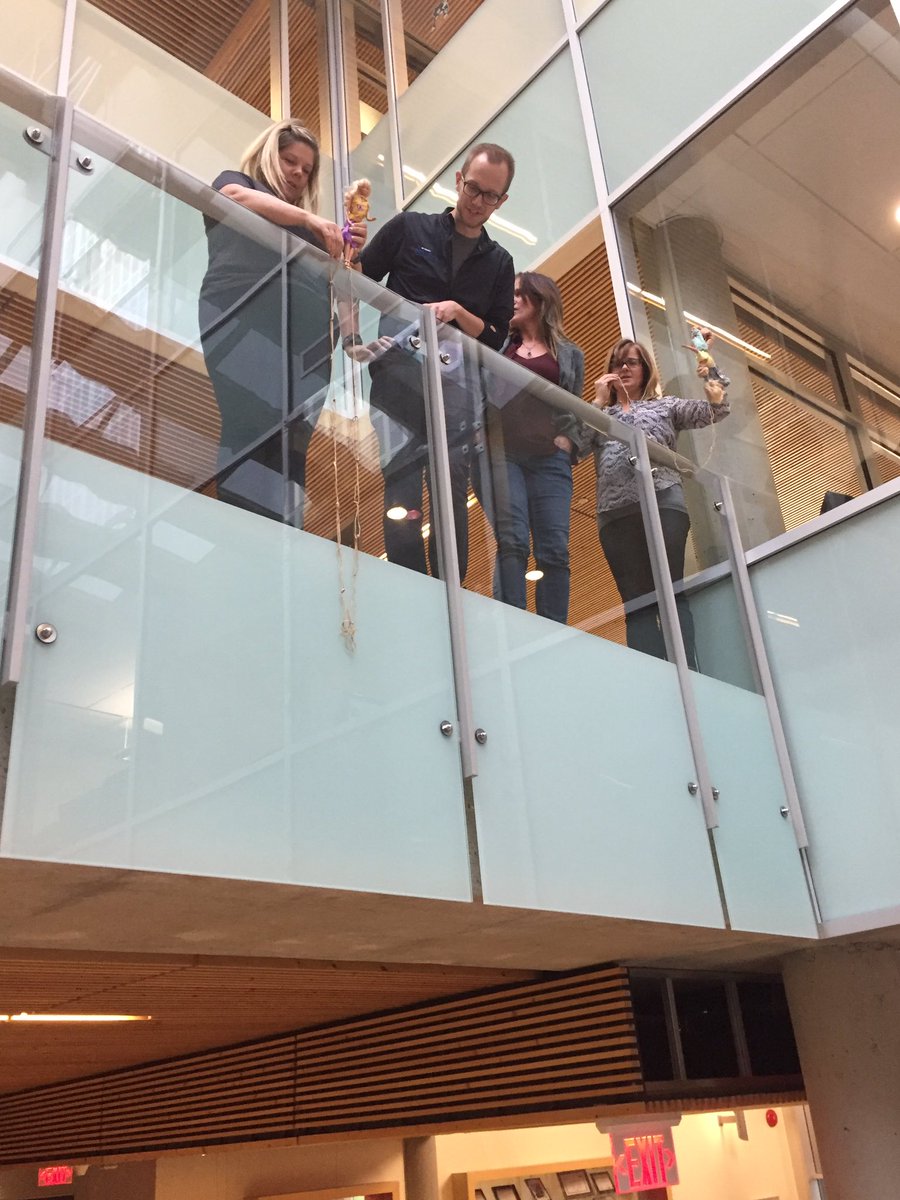
I had the privilege of sharing this idea with an amazing group of grade 4 teachers in the Surrey School District. The new BC Science Curriculum for grade 4 has this Big Idea - Energy can be transformed. Barbie Bungee presents a unique, engaging activity to explore energy transformations. Gravitational energy transforms into kinetic energy as Barbie falls. Then the elastic bands begin to stretch and kinetic (and gravitational) energies are transformed into elastic energy as Barbie slows down. Then it is all reversed as she shoots back up. Students can draw simple energy pie charts to track the energy transformations.

Grade 4 teachers exploring Barbie Bungee energy transformations
The wonderful thing about this for grade 4 is the cross-curricular connections. Barbie Bungee has become a science activity but we don't lose the math. The scientific data that students collect will be used to explore linear relationships. We can connect to the new ADST (Applied Design, Skills and Technology) curriculum as students test and improve their bungee design. And we can extend to design something else using elastic energy like a rubber band car.

Tuesday, November 15, 2016

Small Changes for Inquiry

My personal definition of inquiry goes something like this:
Exploring scientific concepts using scientific skills and processes.
In the language of the new BC science curriculum this means students are exploring Content by doing Curricular Competencies in order to understand the Big Ideas.

As I work with other teachers in the district I am finding there is a fair bit of confusion and anxiety about inquiry. How do we create lesson plans that are more inquiry-focused that allow students to do science? It can seem like a daunting task. Fortunately we do not need to throw out our existing lessons and start from scratch. Small changes can often infuse our old lessons with new inquiry life.

I recently spent a morning with grade 4/5 teachers at Adams Road Elementary planning some inquiry-based lessons. The new grade 5 curriculum contains the following Big Idea:

Earth materials change as they move through the rock cycle and can be used as natural resources.

The Adams Road teachers had a fantastic activity about the rock cycle. Students build models of different types of rocks (sedimentary, metamorphic, igneous) using food. A sandwich is a very effective model of sedimentary rock. And it's tasty.

Whenever I am re-designing a task as an inquiry lesson I simply ask "What am I currently doing that the students could be doing instead?" The student recipe sheets for this activity stated which type of rock each recipe was supposed to model. Identifying the rock type is something the teacher is doing that students could be doing. What if we removed the type of rock from the recipe?

This simple change transforms the activity from a fun and engaging follow-the-steps activity into an inquiry activity that requires students to think deeply. They must identify properties of the model and match them to properties of rocks. They must decide which type of rock the model represents. They have to explain their thinking and defend their reasoning. And it's still fun and engaging. And tasty.

We erased 3 words. Small change. Big impact.


Thanks to the Adams Road Elementary grade 4/5 teachers for letting me share this story.

Saturday, October 22, 2016

Catalyst 2016 - Tuning Protocol

Click the link below to access the PowerPoint presentation and other files from the workshop.

Catalyst 2016 - Tuning Protocol

Thursday, June 12, 2014

Giants and Mermaids and Fairies! Oh My!

I have been following the hashtag #tmwyk and browsing Christopher Danielson's amazing blog and website Talking Math With Your Kids. It's got me looking for opportunities to talk math with my own 6 year old and 3 year old daughters.

At dinner a few nights ago, my oldest daughter offers this bit of wisdom:

S (6 years old):  Daddy, if there was a giant here, his little finger would be as big as you. 
Me:  Wow, that's big! How big do you think his foot would be? 
S:  As big as the table! 
Me:  Can I ask you another question? 
S:  (with big wide eyes in anticipation... or suspicion) OK.
Me:  If there was a fairy here, how big would her little finger be? 
S:  (after some thought) As big as my finger nail. 

L (3 years old):  Ask me one, Daddy! 
Me:  OK, How long is a mermaid's tale? 
L:  (thinking, thinking... grabs a fork) This long! 

At this point I'm a little confused. L loves mermaids and has a good idea what they look like and how big they are. I'm not sure why she has chosen a small fork to represent her tail.

Then some magic happens! She pulls her milk cup over and explains:

L:  If this (cup) is the mermaid, then this (fork) would be her tail.

She has created her own scale model using her place setting. And S (never to be outdone) has her own frame of reference:

S:  If the mermaid was 6 years old, her tail would be as long as my legs.

I thought that was a good place to stop. I was wrong.

L (my wife, ___ years old):  How come I don't get a question? 
Me:  If there was a dragon...

Wednesday, May 14, 2014

Don't Ever, Ever, Ever Take the Pen Out of the Student's Hand!

One of my favourite things to do when students are whiteboarding problems (or designing labs, or playing with manipulatives) is to point at something that is correct and ask "Can you please explain this to me?"

The students' instinct to immediately grab an eraser under the assumption that something must be wrong because the teacher asked about it is incredibly strong and must be squashed.

I want my students to be able to talk to me about physics (or math) even when their answers are correct. Correct mathematical answers do not necessarily correlate to deep conceptual understanding. I want to know what they know. And I want them to be able to explain it to me with confidence.

Of course, I then point out something that is incorrect and ask again "Can you please explain this to me?"

The teachers' instinct to immediately grab the pen (or pencil, marker, crayon, manipulative, mouse, iPad - hereafter all referred to as the "pen") out of the students' hand to "show" them the correct way is incredibly strong and must be squashed.

Don't ever, ever, ever, EVER take the pen out of a student's hand.

Why? These are some of my thoughts:
  • It turns a problem or inquiry activity into a lecture.
  • It makes the teacher an integral part of the conversation (not a good thing).
  • It makes the student a spectator rather than a participant or leader in their learning.
  • It makes the student a listener rather than an explainer.
  • It removes responsibility from the student to explain their thinking and reason through the problem.
  • It negates any opportunity for a student to self-correct by discovering the flaw in their reasoning.
So, I resist the urge to grab the pen. Instead, I continue the conversation something like this:

Me: Can you please explain this to me?
Student 1: We are calculating the coefficient of friction. We know that the force of friction is equal to the applied force.
Me:  How do you know?
Student 1: Because the forces are balanced.
Me: How do you know?
Student 1: Because of Newton's 1st Law.
Me: How do you know 1st Law applies here?
Student 1: Because it is moving at a constant speed.
Student 2: Wait. It's not moving at a constant speed, it's accelerating.
Student 1: What?
Student 3: Ya, see the position graph is curved so there is a change in velocity.
Student 2:  So there must be an unbalanced net force.
Student 1: Oh, I see. So the friction force is not equal to the applied force.
Student 3: But how do we figure out the friction force then?

The entire conversation is student driven. They supply all the arguments and reasoning. The only thing I say is "How do you know?" This forces them to get to their fundamental assumption, the bedrock of their reasoning which is Newton's 1st Law. Once there, the error in their assumption becomes obvious. They self-correct and move on to the next problem, determining the friction force.

Notice how the teacher becomes unnecessary at some point. In fact, I probably walked away around the time that Student 2 jumps in. And I am no where to be found when they start asking what to do next. I am not needed.

And the pen is where it belongs, in the hands of the students.

Friday, June 1, 2012

Collaboration from #ConnectEdCa

You don't get to opt out of standing in front of your colleagues and talking about your practice.
Deirdre Bailey - Calgary Science School

Although this statement was uttered in the context of the philosophy and culture of Calgary Science School, I see it as a call to teachers everywhere to stop hiding behind closed doors.

Our profession allows (and even encourages) practicing our craft on an island alone. New teachers are thrown into a classroom and no one looks in on them again. I tell my students and parents that my colleagues are excellent teachers, but how would I ever know? I have never sat in on any of their classrooms. I have never seen them teach.

Aside from a cursory first year review, no administrator or colleague has been in my classroom for 6 years except by special invitation from me. Of course, I plan these invitations when it is most convenient and flattering to me, when I have some great activity planned or some new technology to trot out.

How can this be?

In politically charged British Columbia, true collaboration has been crushed by the rush for accountability. My school once had planned collaboration time like CSS. It was scheduled every second Friday, teacher-driven and supported by administration. And it died after 2 years because of a government push to control it by making the process accountable to arbitrary goals of student success (read higher test scores). Now, new legislation imposes a punitive teacher accountability process that can only make more teacher's doors close.

But there is still hope.

Hope for challenging dialogue, meaningful constructive criticism, true collaboration.

My colleague across the hall, Blair Miller, has been my collaboration partner for almost 2 years. This despite the fact that we do not teach any of the same courses. Our collaboration has focused on assessment practices and broad pedagogical philosophy (including inquiry and problem-based learning), but always rooted in everyday lesson planning. Through our collaboration, he holds me accountable to the highest possible standards (best teaching practice, student engagement and inquiry, authentic assessment through meaningful feedback) in short, what's best for kids. I can confidently say I would not be the teacher I am today without Blair's constant challenge, encouragement and correction.

It may be daunting. It may make you feel vulnerable. And a little scared. But, collaboration is too powerful for us to continue to hide behind closed doors.

So, open your door, stand in front of a colleague and start talking about your teaching practice.


UPDATE: September 2016

I was thrilled to see the #ObserveMe campaign promoted by Robert Kaplinsky and others. This is exactly what I was talking about back in 2012. Encouraging others to observe your practice and offer feedback is amazing.

I believe it is even more valuable to connect with another teacher you trust for ongoing feedback and collaboration. Blair and I continue to connect and challenge each other despite the fact we are no longer even at the same school.

Trust me. It is worth the risk.

Tuesday, May 29, 2012

Planning Inquiry for Energy Unit

Messy and chaotic planning means messy and chaotic activity. Let the learning begin!

Friday, August 12, 2011

Summer School - Day Thirty - Report Cards

Last day of summer school. Students pick up report cards.

I am thinking about the inadequacy of our reporting system. Specifically 3 things are bothering me:

1. Percentage Grades
Most of my students have a high C+ or low B. What does that mean? No really! Do they understand 74% of the material? What material? What do they know and what do they still have trouble with? How is 74% different from 72%? One is a B and the other is not... why? Is the 74% student who coasted and did little studying really a better student than the 72% who worked really hard?

2. Demonstration of Learning (Growth)
My students have essentially one or two chances to demonstrate learning of any given topic. That's it. Even if they learn it later and demonstrate their new understanding on a final exam, that old failed quiz still haunts them. How much better if they demonstrate mastery in the future, this new data replaces the old? After all, their new knowledge has replaced their misunderstanding. Why can't new grades replace old ones?

3. Specificity of Learning
What do they not understand? What specific topics gave them trouble? Was it conceptual or procedural? If they didn't get the Pythagoras question, was it because they don't understand the theorem? Or because they have poor algebra skills? Or because they mixed up the legs and hypotenuse? I want to know! And really, the student needs to know in order to improve.

Enter standards-based grading. The more I read, the more I like. The B.C. curriculum is organized with specific learning outcomes and achievement indicators. It is a fairly simple task to map these indicators to standards and start tracking student progress in a more specific manner.

The great thing about it is not how it tracks growth or how it gives more specific information. Although that is great. The great thing is how this system helps students learn. It gives specific feedback, time for remediation, and opportunities to demonstrate growth.

The irony of this is how students react. They are addicted to grades. Even as I type this there is a student in my class complaining of how she failed French because she got an 82%.  She will need to go through grade withdrawal. I explained the new system and its benefits and she is terrified. But I know the new system will help her learn.

Summer School - Day Twenty-Nine - Teacher Thoughts

An informal poll of 3 other physics teachers at summer school reveals the following:
  1. Most physics teachers use the majority of class time to lecture yet acknowledge the limitations of lectures.
  2. Most physics teachers do some demonstrations or activities to teach concepts.
  3. Most physics teachers would like to do more labs but have little or no equipment.
  4. Most physics students love labs and activities.
  5. Most physics students don't like writing lab reports.
  6. Most physics teachers don't like marking lab reports.
  7. Most physics teachers grade based on quizzes and tests.
  8. Most physics teachers do NOT use standards-based grading.
  9. Most physics teachers are a little afraid of standards-based grading.
  10. Most physics students are wary of standards-based grading.

Thursday, August 11, 2011

Summer School - Day Twenty-Eight - Review

My summer school class is reviewing for the Provincial Exam, a standardized test required for all grade 10 math students. Fortunately, I have sample exams to help prepare students for what they are likely to see on the exam. In the summer, it is an e-exam. For many students, this will be their first look at an e-exam. Today we tried a sample e-exam from the Ministry of Education website.

The problem with review like this for a class like this is that most students just write the exam as if it were the real exam. When they get to a question they are unsure of, they guess. There is no real attempt to understand the problem and really no value in the review. At the end of the e-exam there is a summary sheet that shows which questions were answered correctly and incorrectly and gives the correct solution. Few students used this data to go back and review concepts unless I specifically asked them to. And then they just went back and guessed again.

What really works for review? Physics! Blog! has some great ideas here and here. But these are for Honours Physics. I am dealing with unmotivated remedial math students in summer school. I wonder what a truly effective review activity would look like in this class.

Wednesday, August 10, 2011

Summer School - Day Twenty-Seven - Assessment

As summer school winds down, students are scrambling to complete projects and missed quizzes in a desperate attempt to boost their grade. They cram for a few minutes and then ask for a quiz. I give them a simple problem and watch them scratch out some incoherent scribbles. Even if they get the answer, it is clear that there is no understanding and no retained learning.

Over the summer, I have been reading a lot about standards-based grading. I think a system like this would correct a lot of the problems cited above. Students would not be scrambling because every standard is reassessable (is that a word?) at any time. They would not be cramming because standards are assessed throughout the course and reflect sustained learning and growth. There would be no incoherent scribbles because students would have a clear understanding of the standard to be assessed.

The biggest problem I have right now is that if a student does not complete a project, I have no data on that particular concept (standard) and the student receives a zero. This may not be because they do not understand or cannot demonstrate mastery. Perhaps the are just lazy or content with their current grade. Either way, it is not a good reflection of their actual learning of concepts in the course. The last minute cramming is more for my benefit than for theirs.

So many things about how I teach are beginning to irk me. This is good. It makes me question what I do and why I do it. I may not get to full blown standards-based grading this school year. But it is on my mind.