Thursday, November 23, 2017

Provoking Student Thinking

Provocations are new to me. As a secondary teacher, I have never used provocations in my teaching. In my new role as District Science Helping Teacher, I work with elementary teachers all the time so I have been exposed to provocations more often. And in my typical professional manner, I am stealing this idea to use it in my classroom.

I recently had an opportunity to share a workshop with my Helping Teacher colleagues. I led them through a lesson on friction using friction blocks and spring scales. I wanted to start the lesson with open play so I created some provocations.


I attempted to craft the provocations to draw out specific learning. In particular, the question: "How slowly can you move the block?" is intended to allow students to observe something specific. Using a spring scale to pull the block, students should notice that the force required to start the block moving is larger than the force required to keep it moving. Pulling slowly makes this very obvious. The spring scale reading will go up, up, up until the block starts to move. Then the reading will drop suddenly as it begins to move. In my physics classes, about half the students notice this on their own during the lab. The provocation is intended to ensure that all students observe this happening.

Of course, I underestimated the creativity of my colleagues. One person picked up the block and moved it very slowly through the air. The block wasn't sliding so no friction. No spring scale was used. There was zero chance to observe what I had intended.

And that is my fault. I thought I had crafted the provocation in a way to get at the noticing I wanted to happen. But my wording allowed for alternate methods that didn't allow for the noticing I wanted. I realized I need to change some words.

What do I really want to happen?

  • I want students to pull the block so it slides across the table because there needs to be friction.
  • I want students to pull the block using a spring scale to see the reading change.
  • I want students to pull the block slowly so the change is obvious.

So my provocation needs to be more specific to make sure these things happen. Here is my new provocation:

What is the smallest force you can use to slide the block?

  • The word slide ensures there will be friction.
  • The word force ensures they will use the spring scale to measure the force.
  • The word smallest ensures they will pull slowly so they can observe the change.

Intentionally crafting the provocation provokes the learning I want my students to experience.

Friday, November 17, 2017

The Question That Drives My Thinking

"What am I currently doing that the students could be doing?"

When I consider the art of teaching through scientific inquiry, this is the question that drives my thinking.

With the shift in the new curriculum towards inquiry learning, many teachers are struggling with what that looks like. Often teachers I work with have fantastic activities they have developed over the years for teaching specific science concepts. Now they are wondering if they have to throw out these great activities and start over.

But often it is just a small change that can transform the activity. Transferring ownership and responsibility of learning to the students. Here is one example about types of rocks. Here is another example about things that float. In each case, taking away something the teacher would normally do and transferring it to the students completely transforms the activity and opens up opportunities for questioning, exploration, experimental design, and student thinking.

Recently I worked with a small group of Surrey elementary teachers. We explored this question: What makes a good inquiry activity? Here are some of our ideas:


There are some wonderful ideas here. My favourites are productive confusion and thinking skills.

Sometimes, even these aspects of inquiry are not enough. One teacher shared an amazing activity she does with her students about the skeletal system using actual bones from a local butcher shop. She was excited about the activity but was unsure if it was truly inquiry. The activity met many of the criteria we generated that are shown in the picture above.

But, the teacher still did most of the explaining and demonstrating using the bones. After a quick discussion, we decided to get the students to observe the bones and explain to the teacher what they were seeing. And suddenly, all the questioning, observing, exploration and thinking belongs to the students.

"What are you currently doing that the students could be doing?"

Tuesday, March 28, 2017

Bath Time Science

Kids are curious.

I want to nurture that curiosity. I want my kids and students to wonder about the world around them, ask questions, and explore answers.

So when my 6 year old daughter was having her bath the other night, we had a great opportunity to nurture curiosity. She was playing with her floaty bath toys and noticed that one of them had sunk to the bottom of the tub.

L: Look Daddy! My octopus sank.

At this point, I believe I have 2 options in how to respond.


1) Explain

Me: Yes, it sank because it is filled with water. The water makes it heavier and it displaces a greater volume of water so it sinks. Here, give me the toy and I will show you.

This approach is OK. She learns something (although my explanation might be a little much for a 6 year old) and I nurture her curiosity by responding to her observation and offering an explanation. I even offer to show her a demonstration by taking the toy and showing her how it floats or sinks.


2) Not Explain

Me: Yes, why do you think the octopus sank?

This is much better. I still nurture her curiosity by engaging her in conversation. But I turn it back on her. She needs to be the one to provide an explanation. Her explanation will be:

  • based on her own observations
  • in her own 6 year old language
  • her own (not mine)

L: I think it sinks because it is filled with water.

Now she has a hypothesis. And again, I am faced with some choices in how to respond.


1) Confirm

Me: Yes! That's right! Good for you! High five!

This approach is OK. I confirm her understanding. Her self-esteem is through the roof. And there are lots of high fives and splashing.


2) Demonstrate

Me: Hmmm. Let's try emptying the water out of the toy and see if you are right. If it floats without water in it then we know it sinks because of the water.

This is much better. I don't just tell her she is correct. I provide a way for us to test her hypothesis. We can perform an experiment to see if she is correct. And she can verify her hypothesis through observation and collecting "data".


3) Not Confirm or Demonstrate

Me: Hmmm. What do you think you could do to see if you are right?

This is so much better than much better! I still nurture her curiosity. I still lead her to think of a way to test her hypothesis. But I turn it back on her. She needs to be the one to design the experiment. Her experiment will be:

  • based on her own hypothesis
  • based on her own creative/critical thinking
  • her own (not mine)

L: I could empty the water out and see if it floats?

Me: OK, why don't you try that.

L: It floats! It floats!


I am not always good at making the best choice for inquiry in the spur of the moment. In my classroom, this has been a huge learning experience for me and an ongoing struggle.

But I am proud to say that during Bath Time Science, I made all the right choices.

Wednesday, December 7, 2016

Barbie Bungee as Science Inquiry

I first discovered Barbie Bungee from Fawn Nguyen's blog Finding Ways. And again on the NCTM Illuminations website. It is designed to be a math investigation into linear relationships and proportional reasoning.

At Frank Hurt Secondary, we have a professional cohort that uses a Tuning Protocol to constructively critique and improve projects and activities. I brought to the group a physics lab inquiry activity I had developed about elastic forces that I was not happy with and wanted to tweak. Through the course of that discussion, a colleague reminded me of Barbie Bungee. But in the context of science inquiry rather than math.

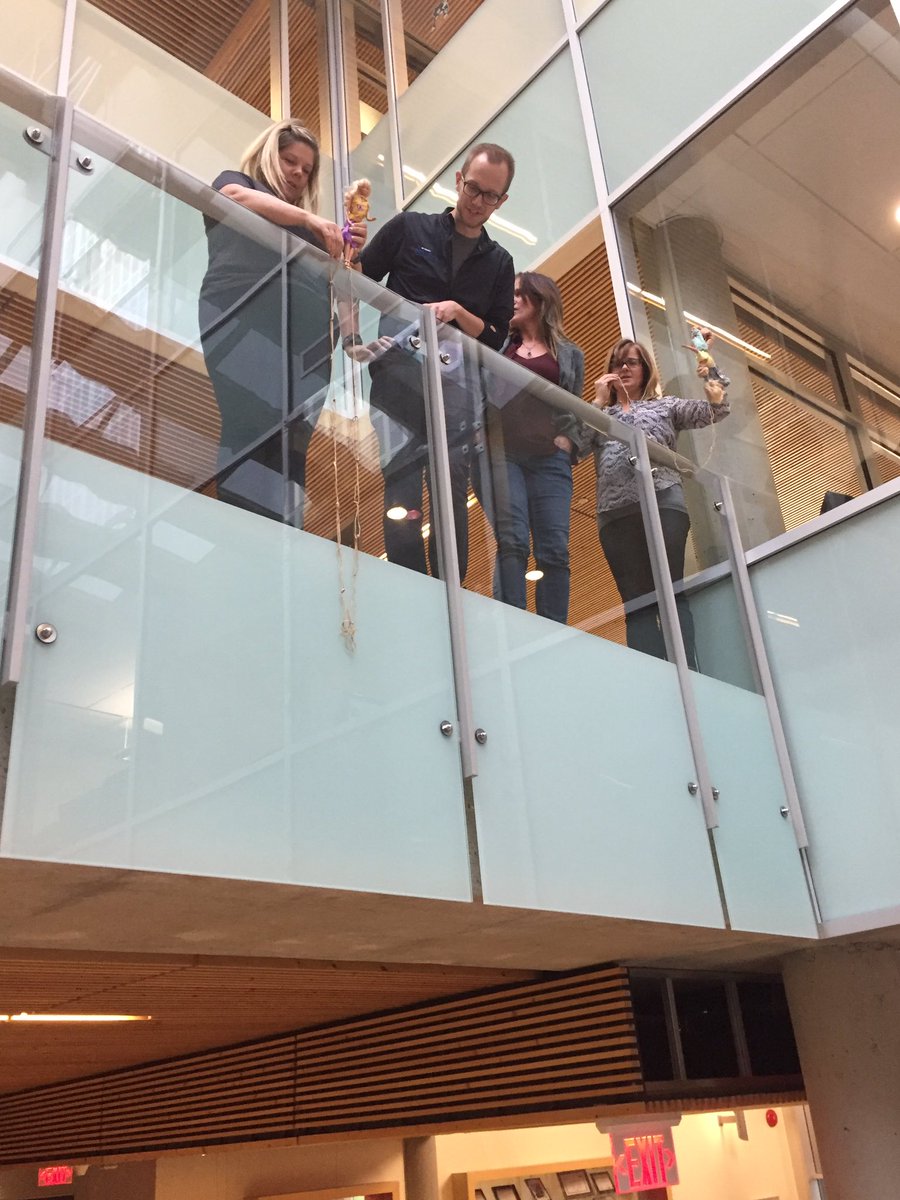
I had the privilege of sharing this idea with an amazing group of grade 4 teachers in the Surrey School District. The new BC Science Curriculum for grade 4 has this Big Idea - Energy can be transformed. Barbie Bungee presents a unique, engaging activity to explore energy transformations. Gravitational energy transforms into kinetic energy as Barbie falls. Then the elastic bands begin to stretch and kinetic (and gravitational) energies are transformed into elastic energy as Barbie slows down. Then it is all reversed as she shoots back up. Students can draw simple energy pie charts to track the energy transformations.

Grade 4 teachers exploring Barbie Bungee energy transformations
The wonderful thing about this for grade 4 is the cross-curricular connections. Barbie Bungee has become a science activity but we don't lose the math. The scientific data that students collect will be used to explore linear relationships. We can connect to the new ADST (Applied Design, Skills and Technology) curriculum as students test and improve their bungee design. And we can extend to design something else using elastic energy like a rubber band car.

Tuesday, November 15, 2016

Small Changes for Inquiry

My personal definition of inquiry goes something like this:
Exploring scientific concepts using scientific skills and processes.
In the language of the new BC science curriculum this means students are exploring Content by doing Curricular Competencies in order to understand the Big Ideas.

As I work with other teachers in the district I am finding there is a fair bit of confusion and anxiety about inquiry. How do we create lesson plans that are more inquiry-focused that allow students to do science? It can seem like a daunting task. Fortunately we do not need to throw out our existing lessons and start from scratch. Small changes can often infuse our old lessons with new inquiry life.

I recently spent a morning with grade 4/5 teachers at Adams Road Elementary planning some inquiry-based lessons. The new grade 5 curriculum contains the following Big Idea:

Earth materials change as they move through the rock cycle and can be used as natural resources.

The Adams Road teachers had a fantastic activity about the rock cycle. Students build models of different types of rocks (sedimentary, metamorphic, igneous) using food. A sandwich is a very effective model of sedimentary rock. And it's tasty.

Whenever I am re-designing a task as an inquiry lesson I simply ask "What am I currently doing that the students could be doing instead?" The student recipe sheets for this activity stated which type of rock each recipe was supposed to model. Identifying the rock type is something the teacher is doing that students could be doing. What if we removed the type of rock from the recipe?

This simple change transforms the activity from a fun and engaging follow-the-steps activity into an inquiry activity that requires students to think deeply. They must identify properties of the model and match them to properties of rocks. They must decide which type of rock the model represents. They have to explain their thinking and defend their reasoning. And it's still fun and engaging. And tasty.

We erased 3 words. Small change. Big impact.


Thanks to the Adams Road Elementary grade 4/5 teachers for letting me share this story.